

St Laurence Church
Infant School
Wellbeing
Emotional Literacy
At St Laurence Church Infant School, we believe that learning to understand and manage our feelings is just as important as learning to read, write and count.
Learning to manage our feelings begins with understanding what they are. For young children, big feelings can sometimes be overwhelming, especially when they don't yet have the words to explain how they feel. We teach children that all feelings are okay, and we all get different feelings at different times, some that feel good in our bodies, like happiness; and some that can feel uncomfortable, like sadness or anger. By describing what we can see from a child's actions, and talking about how they might be feeling inside their bodies, we begin to name and describe those emotions.
Once children can identify how they are feeling, we can help them to understand why they might feel that way, and what might help them if they don't like that feeling. At first, children need the support of a caring adult to help them manage feelings. We call this co-regulation. As children grow in confidence and practise different strategies, they gradually become more able to manage their feelings independently, which we call self-regulation. By helping children to identify and understand their emotions, we are giving them essential skills for lifelong mental wellbeing and positive social relationships.
Meet the Colour Monsters!
As part of our whole-school approach to emotional wellbeing, we use the wonderful stories of The Colour Monster, and The Colour Monster Doctor by Anna Llenas to help children recognise, name, understand and regulate their emotions.
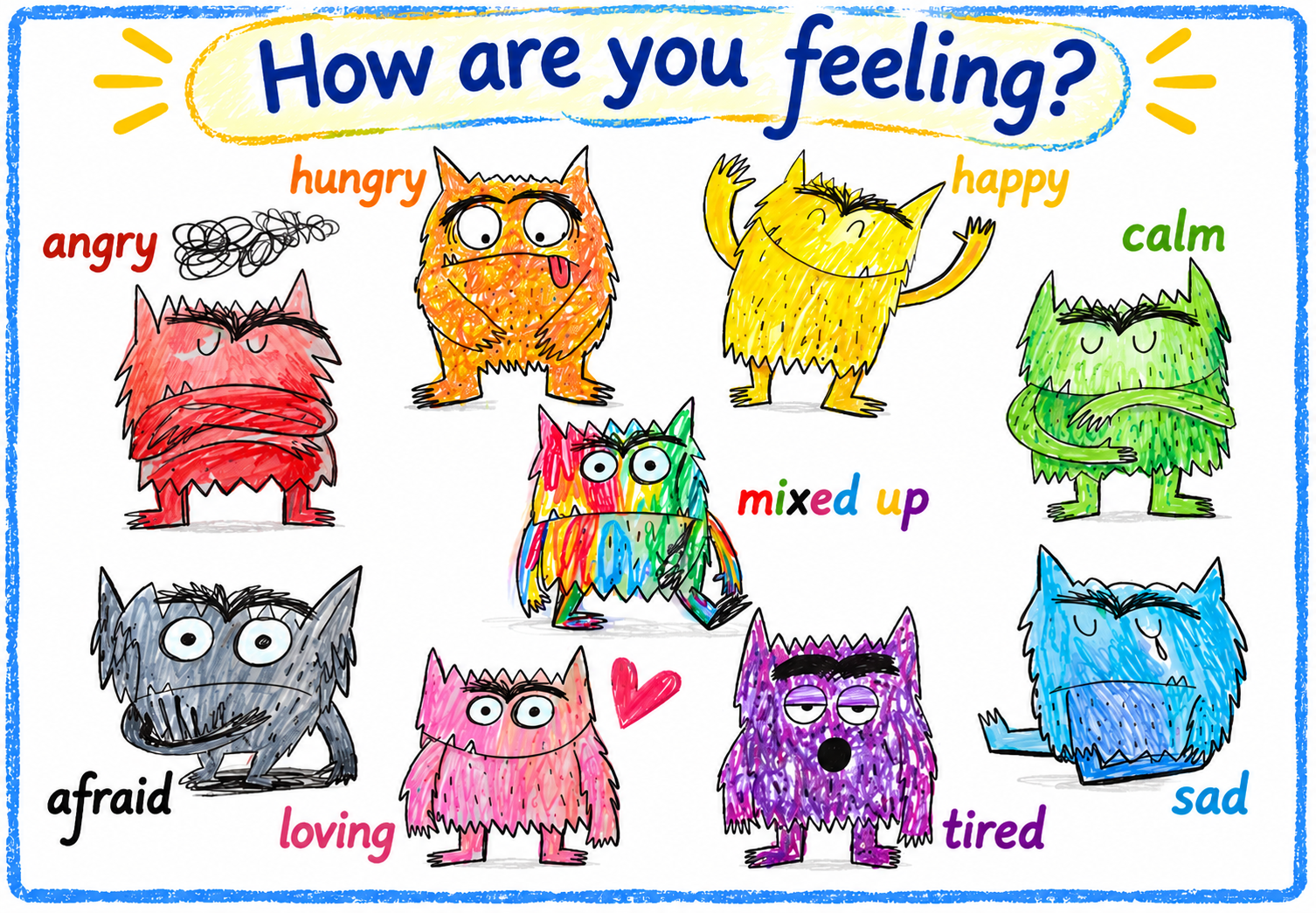
These characters provide a concrete, visual and developmentally appropriate way for young children to explore their feelings. They give us a shared language and imagery across our school, meaning that every adult who they talk to about feelings uses the same approach. The pictures also make it easier for children to communicate how they are feeling, even if they have speech, language and communication needs or when they are dysregulated so can't quite process and use words.
One of the lovely things about using the Colour Monsters is that every child can see themselves in the characters. Unlike a photograph or illustration of a person, which represents a particular age, gender, skin colour or appearance, the Colour Monsters are characters that all children can relate to, creating an inclusive approach.
If you are familiar with the book, you may notice that we have added two monsters of our own that are not in the original story. Our children told us that they needed a Colour Monster for when they want to tell us that they are tired or hungry too. We have also taken care to ensure that the "afraid" Colour Monster is represented and referred to as the "grey", rather than "black" which was in the original version of the story.
How we use the Colour Monsters in school
Every classroom has a Colour Monster display, along with a copy of the book, as part of its Regulation Station. Children are encouraged to check in each morning when they arrive, by placing a peg with their name onto the Colour Monster that best represents how they are feeling. They can also move their peg to a different Colour Monster as their emotions change throughout the day.
The pegs on the Colour Monster display help our staff to recognise when a child might need a little extra care, reassurance or an opportunity to talk to a trusted grown-up.
We understand that not everyone feels comfortable sharing their emotions publicly, so children can also use individual Colour Monster cards to communicate their feelings privately with an adult if they would prefer. Our staff also carry a picture of the different colour monsters on their lanyards so they are always to hand when needed!
Our Regulation Stations
Every classroom has a Regulation Station where children can access resources to help them manage their emotions. In the story of The Colour Monster doctor, we find out different strategies to manage our emotions. Each Regulation Station includes our special Colour Monster Doctor Toolkit, a suitcase containing resources to support emotional regulation.
Children are able to access the Regulation Station if they need to throughout the day. Staff may support a child to use the area and the resources, showing empathy and modelling calm responses. Over time, these experiences help children to become increasingly confident and independent in regulating their own emotions.
No emotions are wrong emotions
We teach our children that there is no such thing as a wrong way to feel. It is natural to feel angry, sad, worried or confused, just as it is to feel happy, calm or excited. We all have these feelings some of the time.
Whilst all feelings are acceptable, we help children to understand that not all ways of expressing those feelings are acceptable. We support them in finding healthy and safe ways to express their emotions, whilst following our three school rules:
-
Be ready.
-
Be respectful.
-
Be safe.
When things go wrong, we help children to reflect on their feelings, understand how others may have been affected, put things right and make a fresh start.
Building skills for life
Our work with the Colour Monsters is woven throughout school life, including our PSHE lessons, Wellbeing Wednesday clubs, collective worship, shared stories and everyday conversations.
Through this approach, we help children to develop:
-
Emotional literacy and self-awareness.
-
Confidence in communicating their feelings.
-
Empathy and understanding of others.
-
Resilience and independence.
-
Healthy strategies for managing big emotions.
-
Positive and caring relationships.
Above all, we want every child to know that they are loved, valued, listened to and understood, whatever Colour Monster they might be feeling like today!
Transitioning to "Zones of Regulation" ready for Junior School
By the end of their time in the Infant School, children are confident at recognising their emotions and have a growing self-awareness which means they are well prepared for Key Stage Two. At St Laurence Church Junior School, they use Zones of Regulation framework to explore children's levels of alertness, understand their bodily responses and develop strategies to regulate themselves.
To support this transition, during the Summer term in Year Two, we explore which zone of regulation each Colour Monster would be part of. By introducing the Zones of Regulation alongside the familiar Colour Monster characters, children are encouraged to make connections between their existing knowledge and the new language they will encounter at the Junior School.
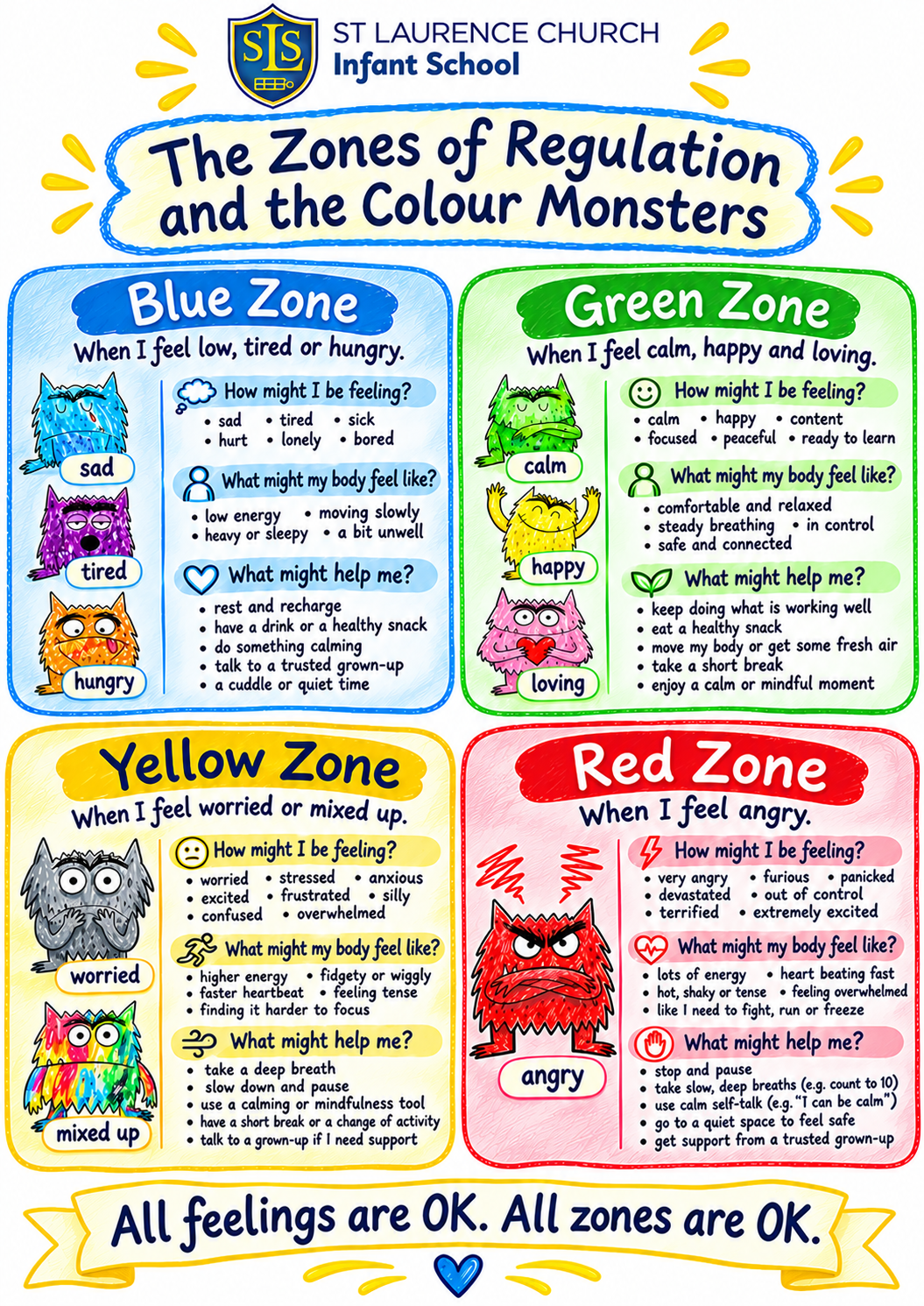
The two approaches are used alongside one another, with adults explicitly modelling the connections between the Colour Monsters and the four Zones of Regulation. As children become increasingly familiar with the zones, the Colour Monsters gradually become a less prominent scaffold, whilst remaining available to children who benefit from them. Children learn that the Colour Monsters each represent a particular emotion, whereas the colour of a zone represents a broader emotional and regulatory state. Feelings may sit within different zones depending on their intensity and how they are experienced by the individual child.
We explain that each Colour Monsters represents a particular emotion, whereas the colour of a zone represents a broader emotional and regulatory state. Feelings may sit within different zones depending on their intensity and how they are experienced by the individual child.
This transitional approach supports continuity of learning and language and emotional security, whilst allowing developmental progression and increasing independence. Underpinning both approaches is the shared principle that all feelings are valid and all zones are OK.
Our approach to emotional wellbeing is rooted in our school vision, “Do all things with love.” By helping children to understand their own emotions and recognise the feelings of others, we encourage them to show kindness, compassion and empathy, both towards themselves and those around them. We want every child to leave our school not only ready for the next stage of their learning, but also equipped with the emotional skills to help them flourish throughout their lives.