
St Laurence Church
Infant School
SEND Information
Here at St. Laurence Church Infant School our vision is to ‘Do all things with love’ so that every child can have a ‘love of learning, life and each other’.
Children with Special Educational Needs and Disabilities need extra support to ensure they can have this. ‘Doing things with love’ challenges us to work hard to be an inclusive school, where adaptions, adjustments and support ensure SEND children can flourish.
Our recent SIAMS inspection (June 2026) found that "Teachers adapt resources carefully so that children who have SEND can flourish."
Our school’s Special Educational Needs and Disability Coordinator (SENCO) is Mrs Louise Evans
Also see:
- Birmingham Local Authority’s Local Offer
- YouTube: Birmingham’s SEND Local Offer
- Birmingham's Inclusion House
- Accessibility Audit and Plan – 2024
You can read about the ways that we work to support children with a range of needs, in our school offer below – simply click on each of the questions to find out more:
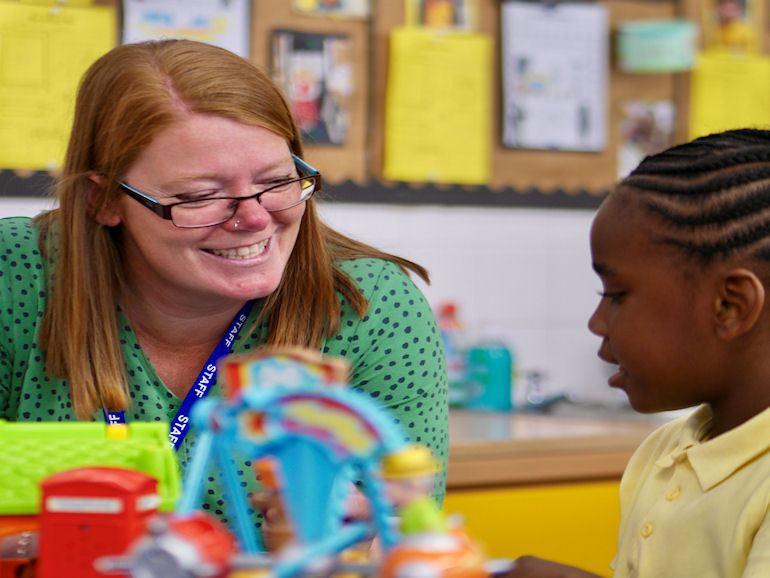
Children are given support to be the best they can be
Q1: What can you expect at St Laurence Church Infant School if your child has special needs?
Open and Honest Communication
At St Laurence Church Infant School if we think your child needs extra support we will always talk with you about this. We will make sure that all the information we need to share with you is clear and easy to understand. We have a Special Educational Needs Co-ordinator (SENCO) who will explain everything to you and make sure you understand what is happening. The SENCO is happy to discuss any concerns you have. The SENCO will make sure all the necessary school staff are aware of your child’s needs. Your child’s progress will be reviewed regularly and you will be invited into school to discuss the outcomes and give your views. Your child will also be able to give their views in an age appropriate way.
A Partnership Approach
At St Laurence Church Infant School we have a commitment to working in partnership with you to identify your child’s needs. We will put in place the necessary support to meet these needs including family support if you need this. We will involve you in all decisions and listen to your views. There may be occasions when we will ask your permission to involve other qualified professionals to support your child. This will be done in discussion with you and we hope you will understand and support the decision. We will be happy to give you contact details for organisations who can give you advice and help to support you and your child.
Appropriate and Effective Teaching and Learning
At St Laurence Church Infant School we will provide at least good teaching for your child; when needed, we will provide extra support. Class teachers will regularly assess children to inform teaching, provide feedback to children and communicate children’s progress to parents. They will know where a child is currently working and what they need to learn next and differentiate the curriculum as necessary. All school staff will receive appropriate training so they have the skills, knowledge, understanding and confidence required to support children’s needs. A range of resources will be provided to support the learning of children with additional needs in all learning areas. St Laurence Church Infant School will provide children who need support managing their own behaviour and/or support building up skills and confidence in dealing with social situations with the help they need. We will make every effort to ensure that children with additional needs and their families are able to take part fully in every aspect of school life.
Read more:
- Birmingham’s Ordinary Available Guidance (OAG) for Parents and CarersPDF File
- OAG Gudes: Additional NeedsPDF File
- OAG Guides: Continuous Professional Learning and DevelopmentPDF File
- OAG Guides: Creating Enabling EnvironmentsPDF File
- OAG Guides: Equity and DiversityPDF File
- OAG Guides: High Quality Adaptive Teaching and LearningPDF File
- OAG Guides: Leading Inclusion in SchoolsPDF File
- OAG Guides: The Team Around the Child and FamilyPDF File
- OAG Guides: Transition Across Life CoursePDF File
- OAG Guides: Understanding the Graduated ApproachPDF File
- OAG Guides: Working Together with Children and FamiliesPDF File
Q2: Who should you talk to about your child’s difficulties with learning or their Special Educational Needs and/or Disabilities?
The SENCO – Mrs Louise Evans
She is responsible for:
- Coordinating all the support for the children Special Educational Needs and/or disabilities and delivering the school’s SEND Policy to make sure all children get consistent and high quality provision to meet their needs in school.
- Ensuring that you are involved in supporting your child’s learning, kept informed about the support your child is getting and involved in reviewing the progress they are making.
- Liaising with all the other people who may come into school to support your child’s learning.
- Overseeing that all staff working with your child are aware of your child’s individual needs and what specific adjustments need to be made to enable them to be included and make progress.
- Making sure there are records of your child’s progress and needs.
- Providing support for school staff so they can help all children with Special Educational Needs make the best possible progress in school.
Your child’s Class Teacher
He/She is responsible for:
- Ensuring that all children have access to teaching that is at least good and that the teaching is adapted to meet the needs of all the children in the class. This is also known as differentiation.
- Checking on your child’s progress and identifying, planning and delivering any additional help your child may need.
- Ensuring that all staff working with your child are aware of your child’s individual needs and what specific adjustments need to be made to enable them to be included and make progress.
- Ensuring the delivery of all planned work for your child so they can achieve the best possible progress.
- Ensuring that the school’s SEND Policy is followed in their classroom.
- Planning and overseeing the work undertaken by the class teaching assistant with children with Special Educational Needs.
The Headteacher – Mrs Catherine Smith
She is responsible for:
- The day to day management of all aspects of the school; this includes the support for children with SEND.
- Delegating responsibility to the SENCO and class teachers but retaining overall responsibility for ensuring that your child’s needs are met.
- Making sure the school has an up-to-date SEND Policy.
- Making sure that the Governing Body is kept up to date about any issues in the school that relate to SEND.
The SEND Governor – Mrs Sheena Rancins
She is responsible for:
- Making sure the school has an up-to-date SEND Policy.
- Making sure the school provides appropriately and makes necessary adaptations to meet the needs of all children in the school.
- Making sure the necessary support is provided for any child attending the school with Special Educational Needs and/or disabilities.
- Making visits to understand and monitor SEND provision and being part of the management process that ensures your child achieves their potential in school.
Q3: What types of Special Educational Need can be provided for at St Laurence Church Infant School?
There are 4 categories of SEND:
- Children with speech, language and communication needs. This category includes children with Autism Spectrum Disorder who are likely to have particular difficulties with social interaction.
- Cognition and learning. This category includes moderate learning difficulties, severe learning difficulties and profound and multiple learning difficulties. It includes specific learning difficulties such as dyslexia, dyscalculia and dyspraxia.
- Social, emotional and mental health difficulties. This category includes behaviours such as being withdrawn or isolated as well as displaying challenging, disruptive or disturbing behaviour. These behaviours may reflect underlying mental health difficulties such as anxiety or depression. Other children may have disorders such as attention deficit disorder, attention deficit hyperactivity disorder or attachment disorder.
- Sensory and/or physical needs. This category includes vision impairment, hearing impairment, multisensory impairment, physical disability. These children will require specialist support and/or equipment to access their learning.
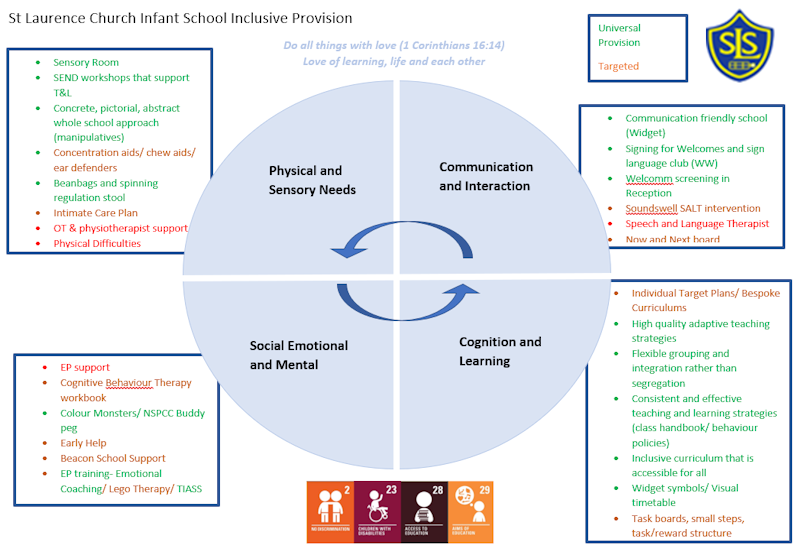
Q4: What will additional support look like at St Laurence Church Infant School?
Children in school will get support that is specific to their individual needs. We refer to this individual support as their Personalised Support Programme. This programme of support may be provided solely by their class teacher. It may also involve other staff in school, staff who will visit the school from Local Authority agencies or other outside agencies.
| Types of support | What this would mean for your child | Who can get this kind of support? |
|---|---|---|
| Class teacher input via targeted classroom teaching also known as Quality First Teaching. |
|
All children in school as required. |
| Specific group work, known as Intervention Groups and delivered as part of the Personalised Support Programme. These groups may be run within the classroom or outside. They may be run by the class teacher or by the teaching assistant overseen by the class teacher. |
|
Any child who has specific gaps in their understanding/learning. Children who have been identified as having Special Educational Needs, as part of the graduated approach. |
| Specialist group or individual support delivered as part of the Personalised Support Programme. |
|
Children with specific barriers to learning that cannot be overcome by Quality first Teaching and Intervention Groups. Children who have been identified as having Special Educational Needs, as part of the graduated approach. |
| Specified Individual Support delivered as part of the Personalised Support Programme. This is usually provided as part of a Statement of Special Educational Needs or an Education, Health and Care Plan (EHCP). |
|
Children whose needs are severe, complex and lifelong. |
Q5: How will St Laurence Church Infant School support my child with Special Educational Needs when they start school?
We will speak to their current setting and visit it to meet you and your child. We will invite you to visit the school and meet key staff. If other professionals are involved we will share information.
Q6: How can I let the school know I am concerned about my child and their progress in school or I wish to make a complaint?
If you have concerns about your child’s progress you should speak to your child’s class teacher initially. If you are still concerned you should speak to the SENCO. If you are still not happy please speak to the Headteacher and if this does not resolve the situation to your satisfaction speak to the school SEND governor.
Mrs Evans, our SENCO, can be contacted through the school office.
Also see our Complaints Policy on our Policies page.
Q7: How will St Laurence Church Infant School let me know if they have any concerns about my child’s learning in school?
When a teacher or you has raised concerns about your child’s progress and Quality First Teaching has not met your child’s needs the SENCO should be made aware of this situation. Every term Pupil Progress Meetings take place between class teachers and members of the senior leadership team to ensure all children are making good progress. These meetings are another way your child may be identified as not making as much progress as they should. If your child is identified a meeting will be set up to discuss this with you in more detail and to listen to any concerns you may have, to plan any additional support your child may receive and to discuss with you any referrals to outside agencies to support your child’s learning.
Q8: How is extra support allocated to children?
The school budget includes money for supporting children with Special Educational Needs. The Headteacher and Governing Body decide on the allocation of resources for Special Educational Needs within the school. All information about SEND in the school and the children involved is taken into account. The Headteacher in consultation with the SENCO decides what training and resources are needs – these are reviewed regularly and changes made as necessary.
Q9: Who are the other people providing support to children with SEND at St Laurence Church Infant School?
The Local Authority’s Access to Education Service provides a range of specialist support services:
- Pupil and School Support
- Educational Psychology
- Physical difficulties Support
- Sensory Support
- Communication and Autism Support
- Behaviour Support
We are also able to refer to Family Support, through Pathfinders, and Safeguarding Teams when this is in the child’s best interests.
Q10: What NHS services can the school refer my child to?
- Speech and Language Therapy
- Occupational Therapy
- School Nurse
- ADHD Nursing Service
- Neurodevelopmental Pathway
- Forward Thinking Birmingham
Q11: How are the teachers in school helped to work with children with SEND and what training do they have?
The SENCO’s job is to support the class teachers in planning for children with SEND. Training takes place on a regular basis. This includes whole school training on SEND issues or individual training courses run by outside agencies.
Q12: How will the teaching be adapted for my child with SEND?
Class teachers plan teaching according to the specific needs of all groups of children in their class and will ensure that your child’s needs are met. Specific strategies and resources will used to support your child individually or in groups. Planning and teaching will be responsive to your child’s needs on a daily basis to meet their needs.
Q13: How will the school measure my child’s progress?
Your child’s progress is continually monitored by the class teacher. Progress is reviewed every term. If your child is in Year 1 or 2 an Individual Target Plan (ITP) will be used to track small steps of progress.
At the end of the Early Years Foundation Stage (Reception) all children are required to be assessed through their class teacher’s observations and professional judgements. The class teacher records each child’s development. The completed assessment is known as the Early Years Foundation Stage Profile.
All children who have an identified Special Educational Need should have their progress reviewed every term and those with an Education, Heath and Care Plan will also have their progress formally reviewed at an Annual Review.
The SENCO will check that your child is making progress.
Q14: What support do you have for the parents of children with special education needs?
We would like you to talk to your child’s class teacher regularly so we know what they are doing at home and we can keep you up to date with what we are doing to support them in school. The SENCO is available to meet you to discuss your child’s progress or any concerns or worries you may have. All assessments from outside agencies and suggestions made by them will be discussed with you and you can meet with them if you feel that would be useful. A home/school contact book may be used to support communication with you when this would be useful for you and your child.
Q15: How is the school made accessible to children with SEND?
We ensure that equipment used is accessible to all children regardless of their needs. After school activities are extended to all children regardless of their needs.
Q16: My child may find moving to another class or to the Junior School difficult. How will the school support this transition?
We know that moving on can be difficult for a child with SEND and take steps to ensure that any transitions is as smooth as possible.
If your child is moving to another school we will contact the school SENCO and ensure that they know about any special arrangements or support that need to be made for your child. When moving to the Junior School there is a carefully planned programme of transition events plus additional resources and visits for children with SEND. We will also ensure that all records about your child are passed on. When moving classes in school we will ensure information is passed on to the new class teacher in advance and ensure that your child is familiar with their new classroom and class teacher.
Q17: What happens if my child’s needs cannot be met by St Laurence Church Infant School?
Most children with Special Educational Needs can have their needs met within their local community. Birmingham Local Authority, in line with all other local authorities, has produced a local offer which is a web based resource with all the information about education, health and care services in one place (launched mid September 2014). It also includes information about leisure activities and support groups. It is clear, accessible and developed and reviewed by its service users. This local offer should help families and setting access all the available support and services in order to meet your child’s needs effectively. If your child’s needs are too complex or severe to be met within the school you can make the decision that special provision may be a better alternative and seek this outcome through the formal assessment process.
Birmingham Local Authority’s local offer detailing information and advice about services available to your family and giving quick access to the directory of services can be read here
St Laurence Church Infant School has a Special Educational Needs and Disabilities Policy and makes reasonable adjustments in line with the Equality Act 2010 and as detailed in the school’s Accessibility Scheme.
Q18: How can I support my child at home?
The document below contains links to websites that will support your children at home.
Please note: External links are selected and reviewed when the page is published. However, the school is not responsible for the content of external websites.
Rights Respecting School
As a rights Respecting School, these rights are particularly relevant to children with SEND:
Article 2. No Discrimination
All children have all these rights, no matter who they are, where they live, what language they speak, what their religion is, what they think, what they look like, if they are a boy or girl, if they have a disability, if they are rich or poor, and no matter who their parents or families are or what their parents or families believe or do. No child should be treated unfairly for any reason.

Article 23. Children with Disabilities
Every child with a disability should enjoy the best possible life in society. Governments should remove all obstacles for children with disabilities to become independent and to participate actively in the community.

Article 28. Access to Education
Every child has the right to an education. Primary education should be free. Secondary and higher education should be available to every child. Children should be encouraged to go to school to the highest level possible. Discipline in schools should respect children’s rights and never use violence.
Article 29. Aims of Education
Children’s education should help them fully develop their personalities, talents and abilities. It should teach them to understand their own rights, and to respect other people’s rights, cultures and differences. It should help them to live peacefully and protect the environment.